Profitable on paper, short of cash: why it happens and what a real cash forecast does about it
Profit counts a sale when you invoice it. The bank counts it when the client pays. Here's why that gap empties a healthy company's account, why the spreadsheet forecast misses it, and what a cash-flow tool built for your business should do instead.
 Reda Bellassery·
·8 min read
Key takeaways
- A company can be profitable and still run out of cash, because profit counts a sale when you invoice it and the bank counts it when the client pays.
- Some cash never shows up in operating profit at all: VAT and tax payments, loan repayments and equipment purchases leave the bank without touching it.
- A monthly spreadsheet hides the week that breaks, assumes clients pay on the due date and never tells you how wrong it was last time.
- A cash-flow tool built for the business ties every weekly number to an invoice or rule, tests decisions before you make them and measures its own error.
- Scenova, my public demo on a fictional 12-person agency, does this with a 13-week forecast, scenarios, a treasury optimizer, 2,000 simulated futures and a backtest.
The accountant says you made money this year. The bank app says something else. Payroll is due on Friday, and you're on the phone asking a client when they plan to pay last month's invoice.
It feels like a contradiction. It isn't. It's one of the most common money problems a small service company has, and it has a boring, fixable cause.
I'm a full-stack developer, and I'm also doing an MSc in Finance & Markets at the University of Macerata. So I built a tool to see this problem clearly: Scenova, a cash-flow decision lab. This post explains the problem in plain words, then shows what a forecast built for the business should do.
It's for owners and finance leads of small companies that invoice clients, pay salaries every month and depend on a few large clients.
Why is a profitable company short of cash?
Because profit and cash are counted at different moments. Under normal accrual accounting, a sale counts as revenue the day you send the invoice. The cash arrives the day the client pays, which can be weeks or months later.
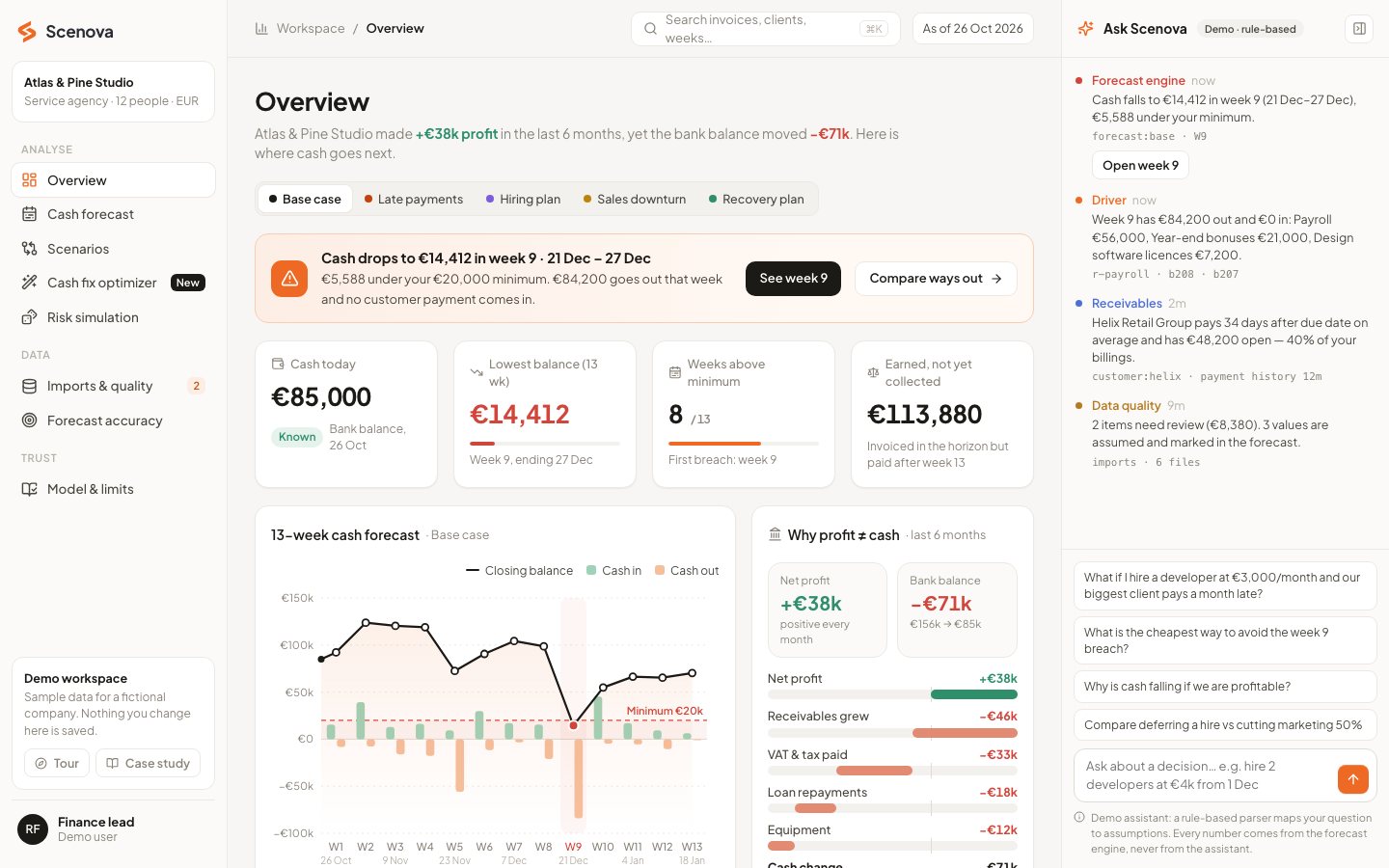
The money you're owed but haven't received is called receivables. When receivables grow, profit goes up and the bank balance doesn't. For example, in the Scenova demo a fictional 12-person agency made +€38k profit in six months while its bank balance fell €71k. Receivables alone grew by €46k.
The bridge on the demo's overview shows the other pieces: cash that never appears in operating profit.
- VAT and tax payments. They leave the bank on fixed dates, whatever your clients did that month.
- Loan repayments. The interest is a cost. The capital you pay back isn't, but it still leaves the account.
- Equipment. You pay for a laptop or a machine today. In the accounts, the cost is spread over years.
Profit tells you whether the business works. Cash tells you whether it survives next month.
What is a cash-flow forecast, and why weekly?
A 13-week cash-flow forecast is a week-by-week plan of the cash you expect to receive and pay over the next quarter, starting from today's bank balance. Each week is simple arithmetic: opening balance, plus cash in, minus cash out, gives the closing balance.
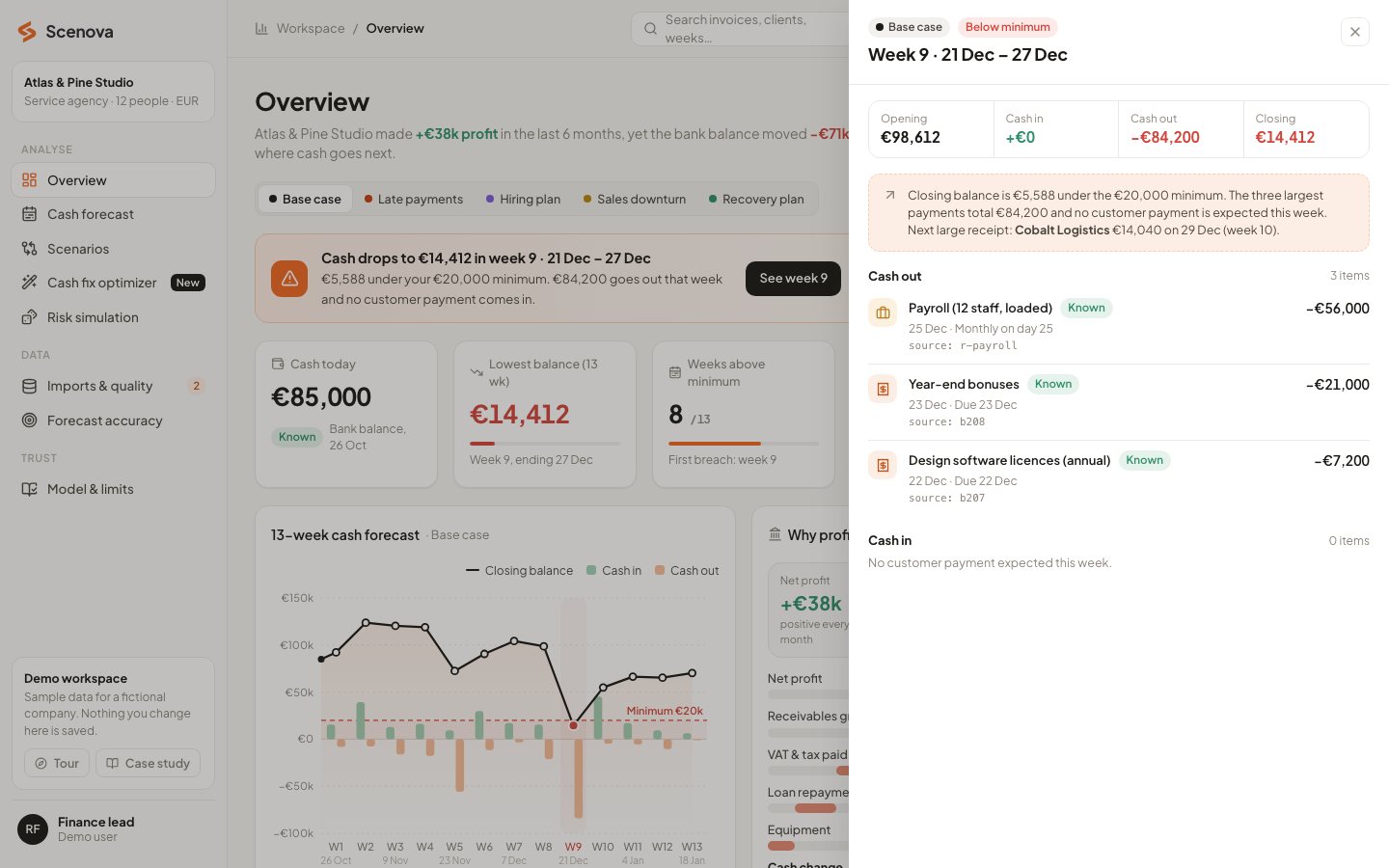
Weekly matters because money doesn't move evenly. In the demo, week 9 has €84,200 going out and nothing coming in: payroll of €56,000, year-end bonuses of €21,000 and software licences of €7,200. Cash drops to €14,412, which is €5,588 under the €20,000 minimum the finance lead set.
Look at the same quarter month by month and that week disappears into an average. The month looks fine. The Friday doesn't.
Why doesn't the spreadsheet forecast catch it?
Most small companies already have a cash spreadsheet. The trouble isn't the tool. It's what a spreadsheet makes easy to skip:
- It assumes clients pay on the due date. They don't. Each client has a habit, and the habit is the forecast.
- It works in months. The week that breaks is hidden inside a month that looks fine.
- Numbers lose their source. Someone typed 48,000 in a cell. Which invoices? Nobody remembers by March.
- There's one future. Testing “what if we hire two people” means copying the file and hoping both copies stay in sync.
- Nobody checks it afterwards. Last quarter's forecast is never compared with what actually happened, so you don't know how far to trust this one.
None of this is the owner's fault. A spreadsheet is a blank page. Doing all of the above by hand, every week, is a part-time job.
How did I build it in Scenova?
I built Scenova alone in 2026 as a public, interactive demo on a fictional company, Atlas & Pine Studio. Everything in it is sample data. It runs in the browser, saves nothing, and the code is on GitHub. It's the proof of approach, not a client result.
The rule behind it: every number must open into the things behind it. Click week 9 and you see each line with its date, its rule and its source, for example a payroll rule or a bill ID. Values are marked as known, assumed or needing review, and two imported items are flagged for a check before anyone relies on them.
Client payments use measured habits instead of due dates. A payment lands on its due date plus that client's average delay. In the demo, the largest client, Helix Retail, pays 34 days late on average, so the forecast plans for that.
What should a cash-flow tool do before you make a decision?
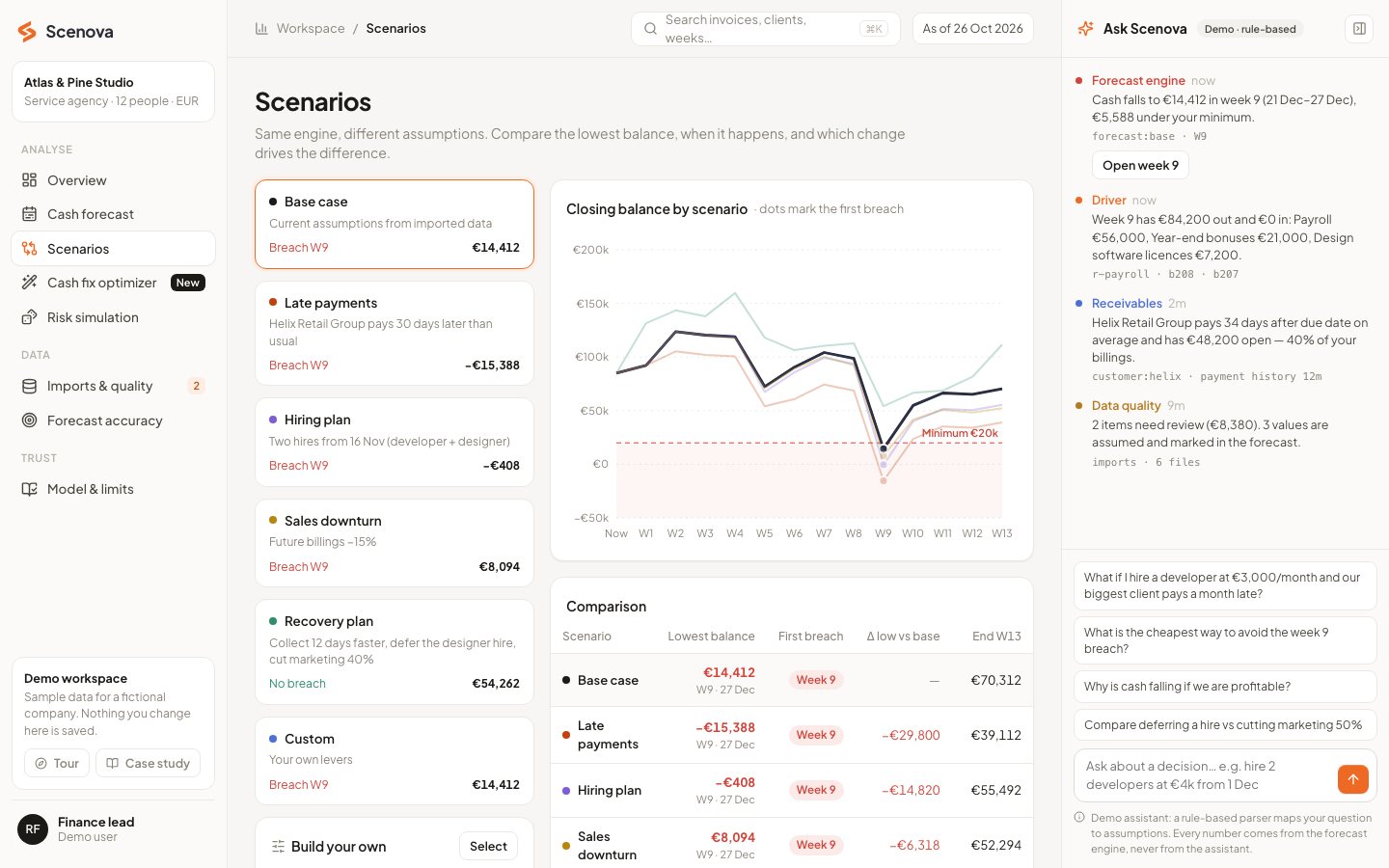
It should let you test the decision on the same numbers first. In Scenova, a late client, a hiring plan, a sales dip and a recovery plan all run through the same engine, so they can be compared week by week.
The answers are concrete. If Helix Retail pays 30 days later than usual, the low point falls to −€15,388. Two hires from 16 November take it to −€408. Each change is measured on its own, so you see which one moves the result. New hires are costed at salary × 1.30 for employer charges, with the first month prorated.
Then there's the fix. The demo has seven possible treasury moves, such as an early-payment discount for clients, moving a vendor invoice, an overdraft and a tax deferral. With seven moves there are only 128 combinations, so Scenova runs every one through the full forecast.
The cheapest plan, a one-month tax deferral, costs €38 and keeps cash above the minimum. But it clears it by only €3,912, and in 14% of simulated futures cash still breaches. Adding a vendor move costs €188 and cuts that share to 7%. The page shows both and leaves the choice to the finance lead.
Each move is also tagged with who has to say yes: a client, a vendor or the tax office. That's the part a spreadsheet never tells you. Whether a move like a tax deferral is possible for your company is a question for your accountant, not for software.
How do you know if the forecast is any good?
You test it against the past and against something simple. A forecast with no error measure is a guess with decimals.
Monte Carlo, in plain words. Instead of one future, Scenova runs 2,000. In each one, payment delays are drawn from each client's own history and sales vary. In the demo, 44% of those runs fall below €20,000 at least once, and in a bad case (the 10th percentile of runs) the low point is €7,835. That's a share of model runs, not a promise about the real world, and the page says so.
Backtest, in plain words. Scenova replays 17 past weeks using only what was known on each date, then compares its receipts forecast with what actually arrived. Four weeks out, its error is 16%. Simply averaging the last four weeks gives 35%.
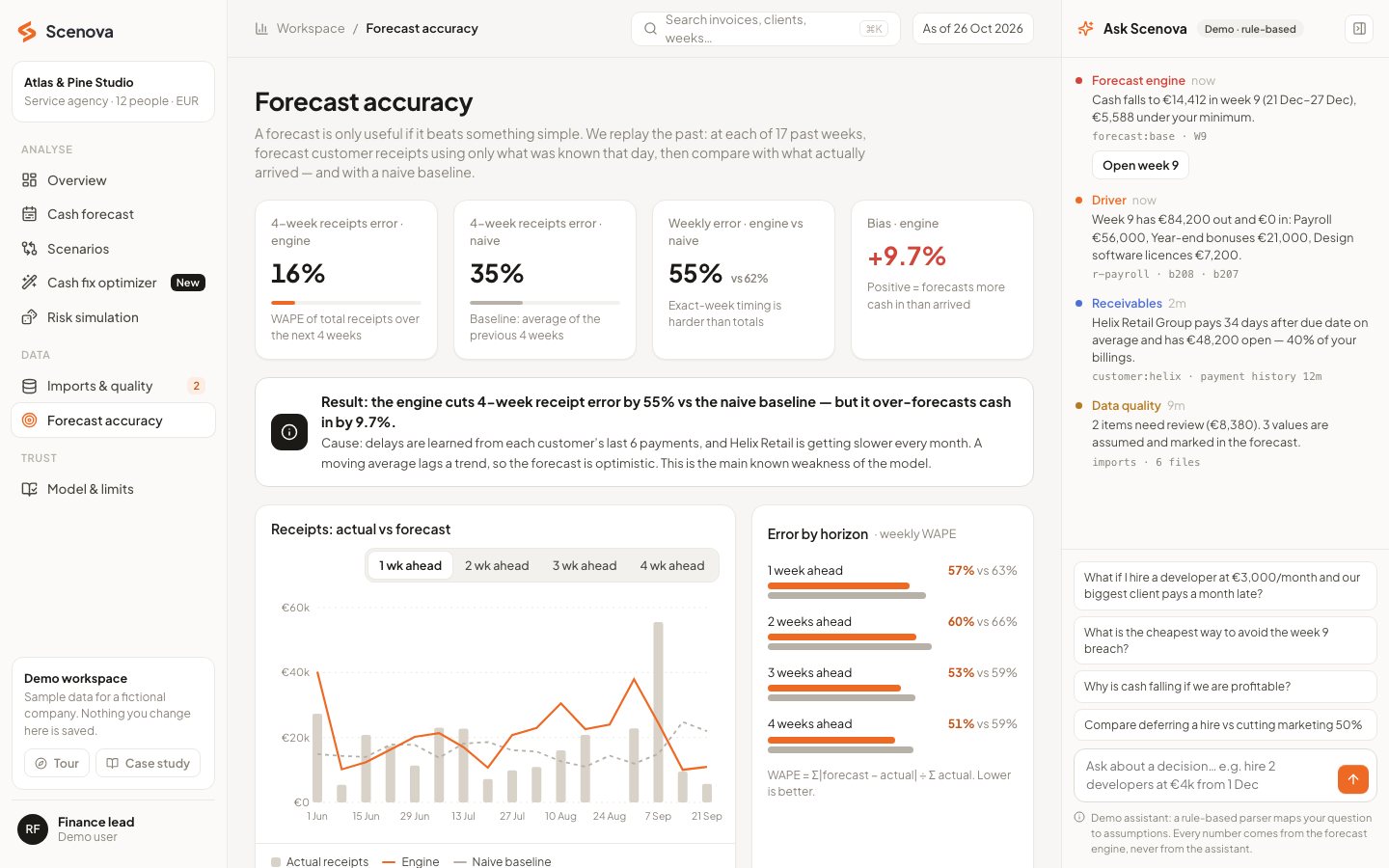
What went wrong first: my first version, with one payment date per invoice, lost to that naive average. A spread of possible dates won. And the engine is still about 10% too optimistic, because Helix Retail pays later every month and averages lag a trend. That weakness is written next to the result, not hidden.
Spreadsheet or custom tool: how do you decide?
A custom tool isn't always the answer. Here's the checklist I'd use with any owner:
| A spreadsheet is probably enough if… | You likely need a tool built for you if… |
|---|---|
| Most clients pay on time | A few large clients pay late, each in their own way |
| Cash out is steady through the month | Payroll, bonuses and tax payments cluster in some weeks |
| You rarely face a big decision | You regularly ask “can we hire?” or “what if they pay a month late?” |
| One person keeps it and trusts it | Several people edit copies and nobody knows which is current |
| You've never been surprised by the bank | The balance has surprised you more than once this year |
| Invoices live in one place | Invoices, bills and payroll sit in different systems |
If most of your answers are in the right column, the spreadsheet is costing you more than it saves. If your invoices are still typed in by hand, start there: I wrote about automating invoices and PDFs with an approval step.
What does it cost, and what are the trade-offs?
The honest costs are data and discipline, more than code. A forecast is only as good as the invoices, bills and payroll rules you feed it, so the first job is getting those out of wherever they live today.
Scenova is about 4,600 lines of TypeScript with 19 tests. Its limits are listed on its own Model & limits page. Clients are simulated independently, future sales are a flat rate, and credit lines and VAT on new invoices aren't modelled yet. The full search of every plan also stops being practical somewhere past fifteen moves, where a solver would replace it.
A tool for your company would start from your data and your questions, not the demo's. I agree the price in writing, with the scope and timeline, before any work starts.
What should you do next?
Start this week, even without software. Write down your bank balance, every invoice you're owed with the date each client usually pays, and every payment due in the next 13 weeks. Then add up each week. If one week goes under the minimum you're comfortable with, you've found your week 9.
If you want to see the whole approach, read the Scenova case study or open the live demo from there. If you want a forecast like this built on your own numbers, look at what I build and tell me how you invoice and get paid. I'll reply with questions or a plan for a first call.
About the screenshots: every image comes from the public Scenova demo. The company, Atlas & Pine Studio, its clients and all of its numbers are fictional sample data.
Questions people ask
Why is my company profitable but short of cash?
What is a 13-week cash-flow forecast?
Is a spreadsheet enough for cash-flow forecasting?
What does a Monte Carlo simulation tell a business owner?
Can you build a cash-flow tool for my company?
I build AI agents, web apps and mobile apps for businesses, and I run my own agency, Barmjli. I write here about what I build and what it taught me.